

DESIGN LEADERSHIP / OCTOBER 2022–OCTOBER 2026
Building design teams around the work
How I grew two design teams at Lite e-Commerce by matching people and responsibilities to what each product needed next.
I stepped into the Head of Design role at Lite e-Commerce in October 2022. Over the next four years, I defined roles, recruited designers and researchers, and supported their development. At peak, the two design teams I led had 16 people in total and supported four products.
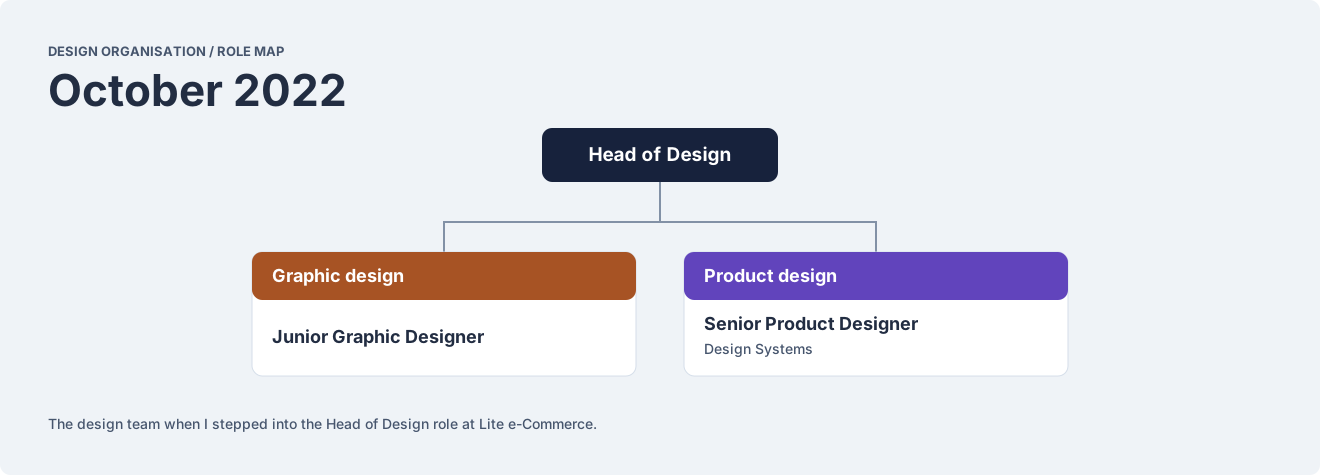 View full-size October 2022 role map
I had already helped recruit a Junior Product Designer before taking on the role, creating and reviewing a design exercise and assessing portfolios. As Head of Design, I started further upstream: What is slowing the team down, what expertise would help, and who should own the work? Sometimes the answer was a new hire. Sometimes it was giving someone already on the team more room to lead.
Hire for the problem at hand
One of my first hires was a Senior Product Designer with deep design system experience. The initial app and web designs for delio had come from different agencies and taken different visual directions. Our team was responsible for making the experience feel coherent at launch. Bringing in a specialist helped us decide what to standardise first and establish components we could reuse across our e-commerce products.
Delio also needed stronger UX and research skills. I hired a product designer who helped keep implementation moving while we tested how customers navigated product categories. That gave us a better basis for making changes to the category structure.
Internal tools required a different profile. As Jush! and delio grew, the technology team began building tools for delivery and fulfilment. I hired a designer who could work independently with engineering and operations on workflows for couriers, logistics managers and packing teams. That gave the work a dedicated owner who could also take on subsequent internal projects.
Build the Żappka team while defining the product
In 2023, I was asked to build a design team for a new Żappka app. I ran concept workshops where designers could sketch ideas, challenge assumptions and compare different directions. We turned the work into an initial set of wireframes, and the supervisory board approved the concept.
I like to leave room in workshops for ideas that might seem too ambitious at first. A rough prototype lets the team find out what is useful about an idea before we spend time resolving every constraint.
To give Żappka the attention it needed, I appointed a Lead Designer at Lite to take on part of my remit and assigned a product designer to Żappka from the start. She and I interviewed stakeholders across the organisation and drafted the sign-in and code-scanning flows so engineering could begin planning while discovery continued.
With a year from kickoff to launch, I hired an experienced researcher and brought in agency support. That let us investigate how the organisation worked, observe customers in physical stores and speak to potential users in parallel. The findings gave the product team a clearer basis for deciding which direction to take.
As the work grew, I added product design, visual design and illustration, design system expertise, and junior research support. I brought in temporary agency designers and hired a Design Lead to coordinate day-to-day work. By December 2023, the team had grown to seven and presented the visual direction, exploratory findings and roadmap to the supervisory board. A UX writer joined two months later to adapt the voice of the physical stores for the app.
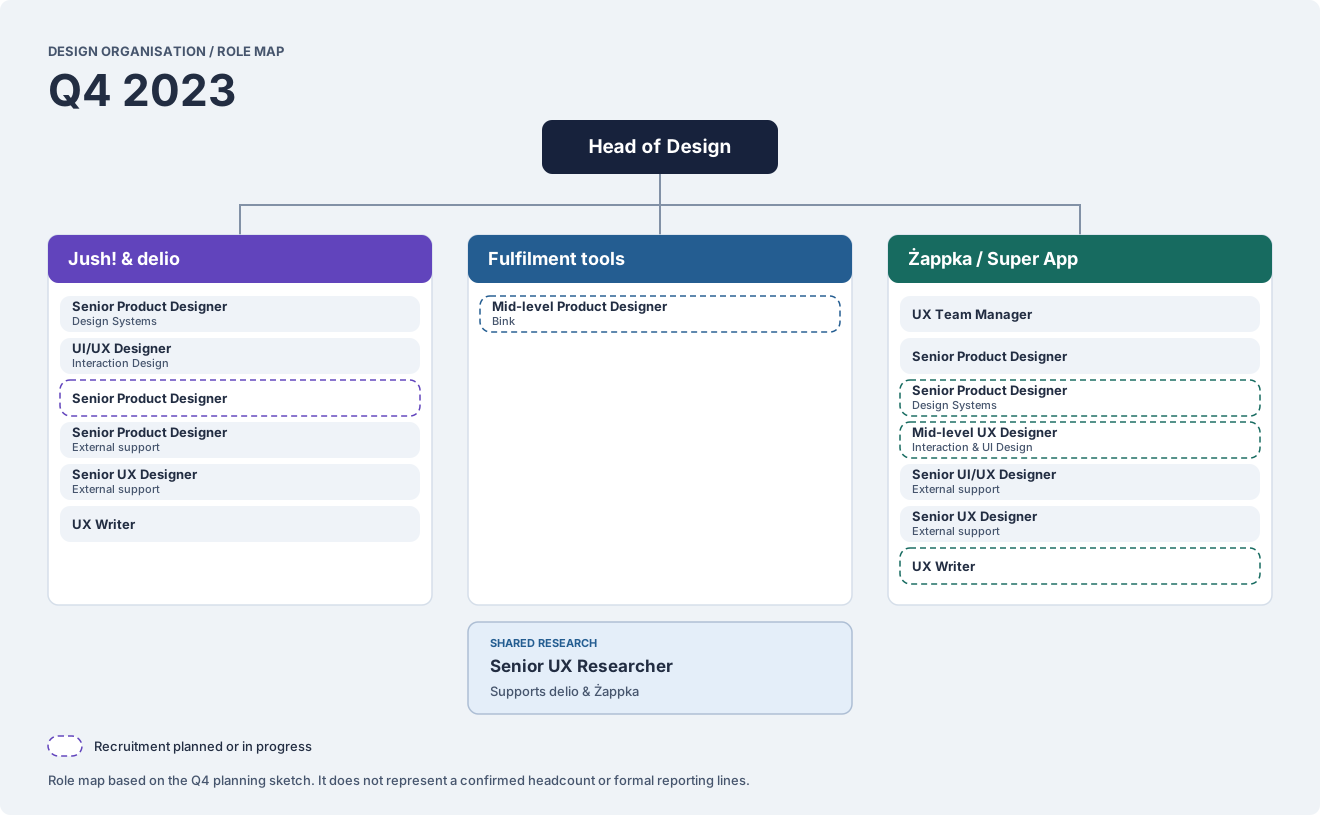 View full-size role map
I also set up regular sessions with key departments so designers could hear feedback directly. We used workshops to explore options and shorter sessions to get decisions. The new Żappka MVP launched in October 2024. The design team later moved to Green Hive and continued working on the product with largely the same people.
Change the team as the work changes
For Maczfit, I assembled a small team of two designers I hired and two agency designers. The team interviewed customers to understand how they chose a meal plan and what mattered when using the app and website. We proposed a visual direction and priorities for the digital products, then handed the work over to Maczfit’s internal team.
Two designers from that project moved to Lite as we began bringing Jush! and delio into one app. The challenge was to make the choice between services clear to customers. I worked with the team on alternative service models and shopping journeys, then ran workshops with leadership to discuss the trade-offs. I brought in temporary UX and product design support, and within two weeks we were ready to test the concepts. A researcher from Żappka led the focus groups and documented the findings. Leadership observed the sessions and heard directly how customers understood the combined offer before choosing a direction.
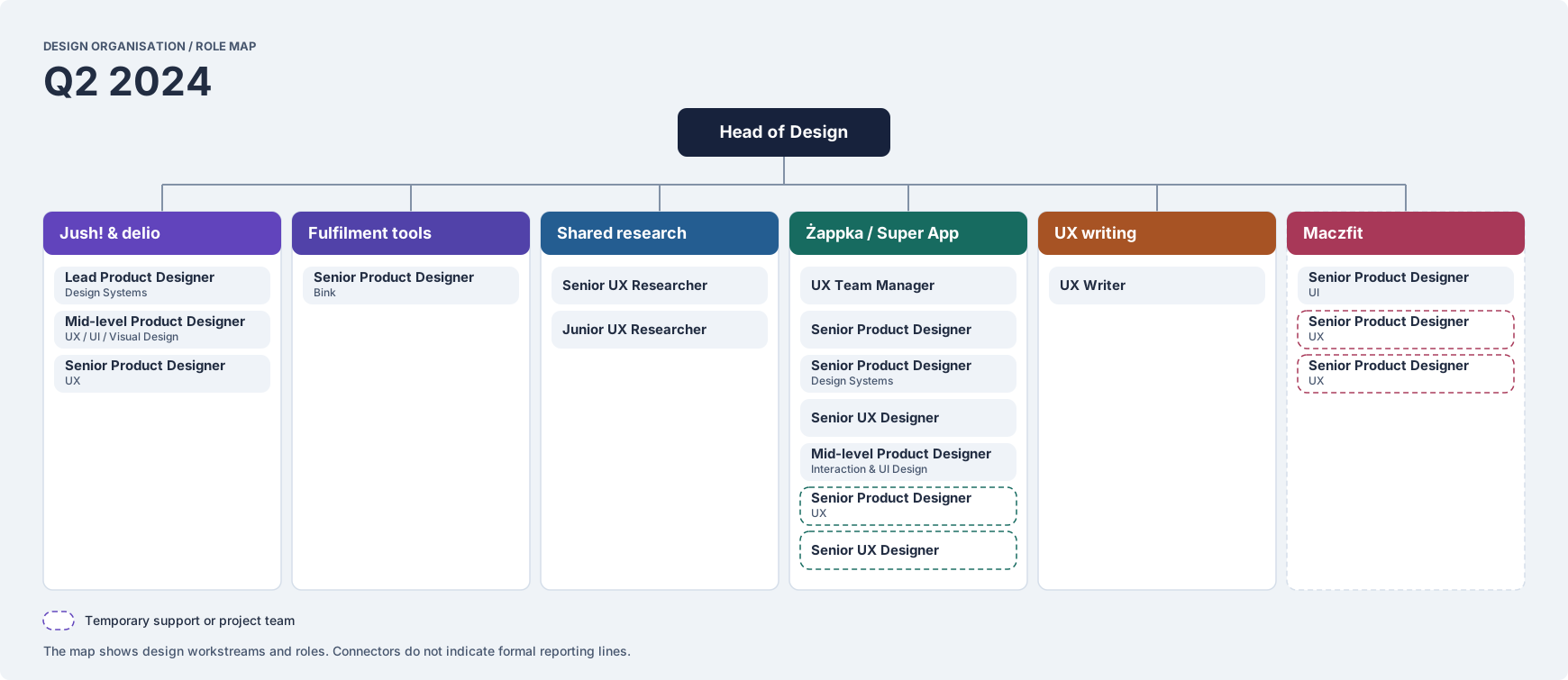 View full-size Q2 2024 role map
Give recurring needs a clear owner
When Alcostore started in January 2025, we had four months to launch the MVP. It had to feel connected to Jush! while supporting a distinct shopping journey across iOS, Android and web. I hired a designer with web expertise and retained a specialist in UI, illustration and visual design. By reusing components from our existing design systems, we had a substantial portion of the design ready to refine with engineering after the first month. The MVP launched four months after kickoff. The same designers continued working on the product and later took on another internal order management tool.
I took a similar approach when I saw how often Marketing relied on agencies for recurring asset production. I proposed hiring a Junior Graphic Designer and offered to manage the role. A direct feedback loop between Design and Marketing shortened turnaround and gave work that sat between product, marketing and merchandising a clear owner.
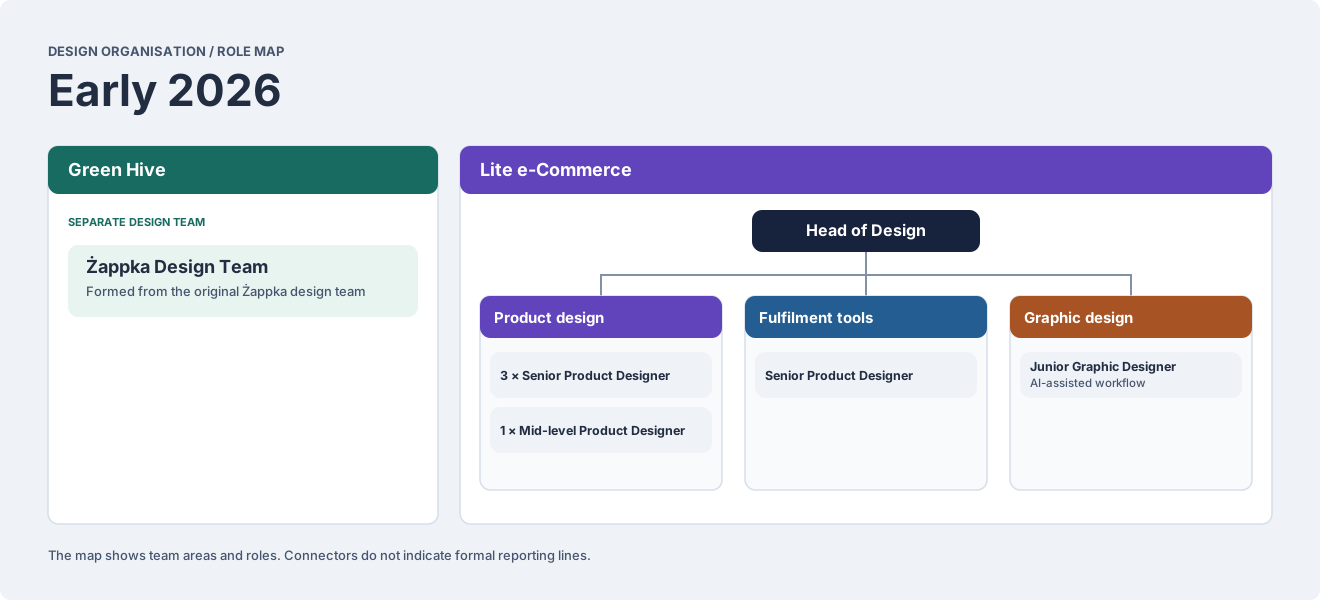 View full-size Early 2026 role map
What I took from it
By October 2026, the part I was proudest of was seeing people continue developing products and take on new ones with ownership of their own decisions. Hiring helped when the team needed expertise it didn’t have. Delegating helped when capable people needed room to lead. And setting up direct conversations helped when waiting for information was the real bottleneck.
That is how I think about scaling design: notice what is getting in the way, decide who is best placed to address it, and give them the context and responsibility to move the work forward.